
Copper has traditionally been the default conductor for many power-distribution projects, but 2026 has made that default worth examining more carefully. Copper prices have approached record levels while utilities, data centers and industrial projects are demanding more electrical infrastructure. Reuters reported that manufacturers in several sectors are already substituting aluminum where engineering requirements permit, while the International Energy Agency expects global electricity demand to grow by an average 3.6% a year through 2030.
Higher Copper Prices Change the Calculation, Not the Engineering
That combination of stronger demand and volatile metal costs makes aluminum economically interesting, but price should only start the discussion. Reuters reported in June that JPMorgan expects aluminum substitution to displace around 2% of global copper demand in 2026, potentially rising to 6% by 2030. The same economic pressure that is changing automotive wiring is relevant to building and industrial distribution, where conductor volumes can be substantial.
A project engineer therefore needs to compare complete installed systems rather than simply copper and aluminum prices per tonne. Conductor size, resistance, allowable current, termination design, cable weight, pulling requirements and installation labor can all change the final result. A qualified Aluminum Alloy Power Cable Supplier should be able to provide the electrical and mechanical data needed for that comparison rather than relying on a generic claim that aluminum is cheaper.
Alloy Performance Matters More Than the Word “Aluminum”
Once the comparison moves beyond metal price, conductor formulation becomes important. Pure aluminum, conventional aluminum alloy and engineered rare-earth alloy conductors should not automatically be treated as interchangeable. Tengyuetong, for example, describes its conductors as rare-earth ferrosilicon aluminum alloys developed to improve creep resistance, flexibility, ductility and connection stability.
Those characteristics matter because connections are one of the places where conductor behavior becomes practical rather than theoretical. Repeated thermal cycles can place stress on improperly designed terminations, while a conductor that is difficult to bend or has excessive rebound can increase installation effort. Buyers evaluating a Rare Earth Aluminum Alloy Cable Manufacturer should therefore ask for type-test documentation covering electrical properties alongside elongation, bending, corrosion and mechanical performance.
This is also where supplier verification matters. Tengyuetong lists more than 20 invention and utility-model patents and publishes inspection and type-test documentation on its certification pages. Such documents do not eliminate the need to verify a specific cable against the project’s governing code, but they provide more useful procurement evidence than an unsupported material comparison.
Armor and Installation Can Shift Total Project Cost
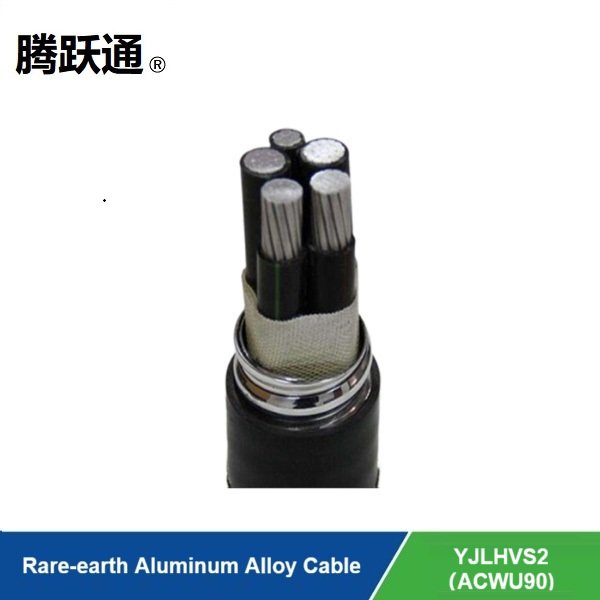
The mechanical discussion naturally leads to cable construction, because conductor savings can be lost if installation becomes more complicated. Tengyuetong’s YJLHVS2/ACWU90 product combines an alloy conductor with XLPE insulation, interlocked aluminum-alloy armor and an outer sheath. The manufacturer specifies applications from 600 V to 35 kV and describes installation in dry or damp locations as well as selected direct-burial arrangements.
For buyers comparing a China ACWU90 Cable Manufacturer with conventional cable systems, the relevant question is not simply the cost per meter. Interlocked armor can provide mechanical protection while retaining flexibility, potentially changing requirements for conduit, pulling work or supporting accessories depending on local regulations. That can make installation labor an important part of the economic comparison.
- Check the required voltage rating and conductor cross-section against the actual load calculation.
- Confirm whether armor, sheath and flame-performance requirements match the installation environment.
- Review connector compatibility and installation instructions instead of assuming copper termination practices apply unchanged.
- Request the test reports and certificates applicable to the exact cable construction being quoted.
Grid Expansion Makes Supplier Capacity Part of the Specification
Installation performance is increasingly important because cable itself is becoming a procurement bottleneck. The IEA reports that typical cable lead times have reached two to three years and that prices for cable orders have nearly doubled since 2019. It also estimates that annual grid investment must rise roughly 50% from today’s $400 billion level by 2030.
Major cable producers are already responding. Nexans acquired U.S. manufacturer Republic Wire in June 2026, adding low-voltage copper and aluminum wire capacity, while Prysmian reported 13% organic growth in its Power Grid business during the second quarter. These developments suggest that buyers will increasingly evaluate manufacturing capacity and delivery reliability alongside product specifications.
For that reason, an Aluminum Alloy Power Cable Supplier serving infrastructure projects should be assessed on production capability as well as metallurgy. Tengyuetong states that its Shenzhen-based operation includes 60,000 square meters of factory space and monthly production capacity of 500,000 meters. A manufacturer producing rare-earth aluminum alloy cable at industrial scale can be more useful to a project than a supplier that meets the specification but cannot support the required delivery program.
The Better Choice Depends on the Whole Circuit
That brings the comparison back to its starting point: aluminum alloy should not be selected merely because copper is expensive. Nor should copper remain the automatic specification simply because it is familiar. The right decision follows from electrical performance, connections, mechanical construction, installation conditions, compliance documentation, availability and total installed cost.
A capable Rare Earth Aluminum Alloy Cable Manufacturer should make those variables easier to verify. For armored applications, buyers evaluating a Chinese ACWU90 cable source should additionally examine conductor construction, armor design, bending requirements, sheath material and the standards attached to the specific export configuration.
Copper volatility may be what brings aluminum alloy into the procurement conversation, but sound engineering is what determines whether it stays there. As grids and data-center power systems expand, the projects that benefit most will be those that treat conductor material as one component of an engineered distribution system rather than as a commodity bought on price alone.